


Wrist Injuries & Conditions
Wrist pain has dozens of possible causes — from the nighttime numbness of carpal tunnel syndrome to a fall on an outstretched hand that may or may not have broken a bone. Because the wrist is a small, intricate joint built from eight carpal bones, two long forearm bones, and a dense network of tendons, ligaments, and nerves, the right treatment depends entirely on the right diagnosis. Aptiva Health treats the full continuum of wrist injuries and conditions — from acute fractures and sports injuries to chronic carpal tunnel and arthritis — across our locations in Louisville, Elizabethtown, Mount Washington, Lexington, Northern Kentucky, and Indianapolis. With on-site X-ray and MRI, same-day and walk-in appointments, and a board-certified orthopedic team led by Dr. D. Philip Stickney, we find the source of your wrist pain and build a clear treatment plan.
Medically reviewed by D. Philip Stickney, MD and the Aptiva Health Orthopedic team — June 2026.
Schedule your appointment today!
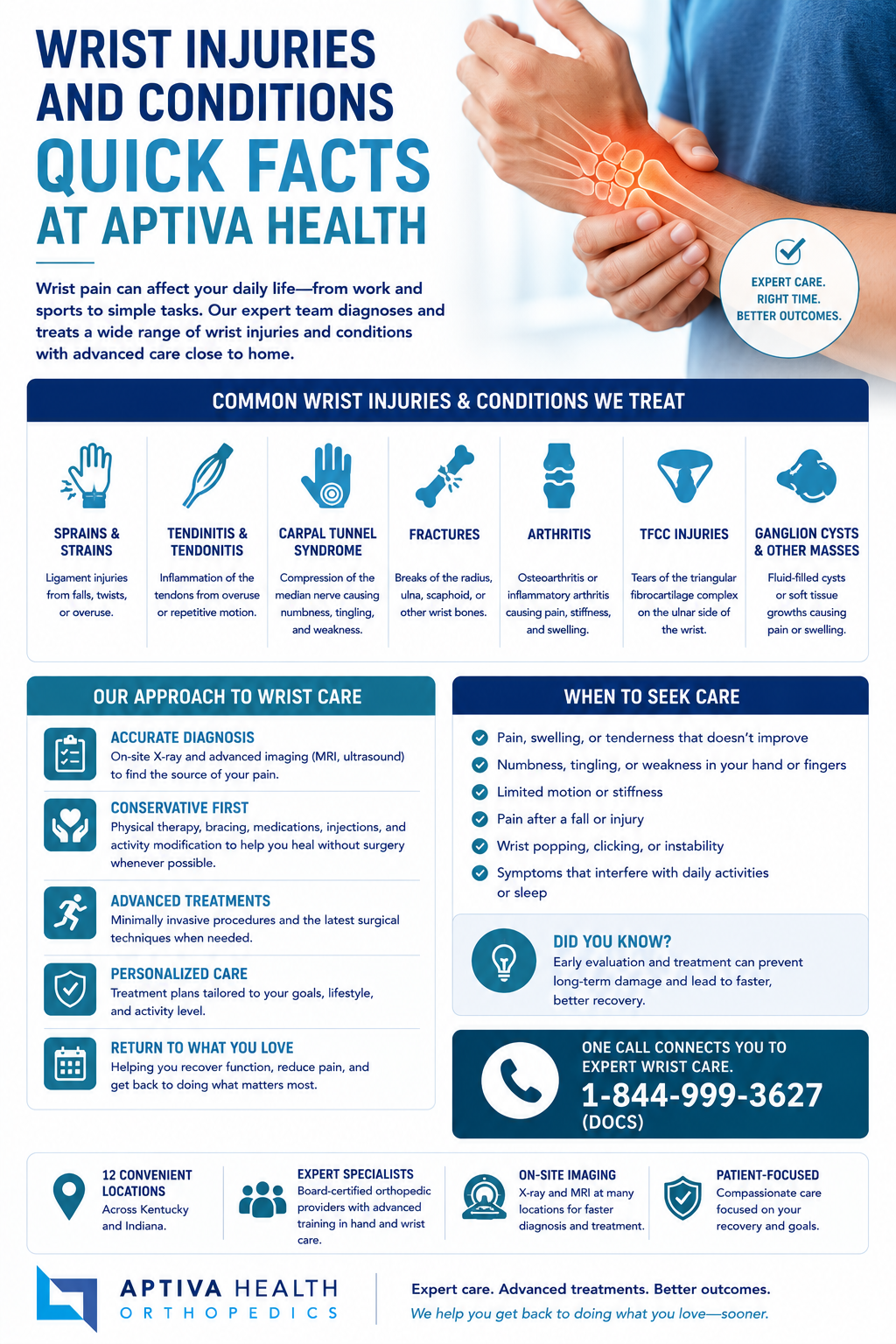
Wrist Problems — The Short Version
The five categories of wrist problems: Nerve compression disorders (carpal tunnel and cubital tunnel), tendon conditions (De Quervain's, trigger finger, tendonitis), acute injuries and fractures (distal radius and scaphoid fractures, sprains, TFCC tears), joint conditions (arthritis and gout), and soft-tissue cysts (ganglion cysts).
Most common wrist condition overall: Carpal tunnel syndrome — affecting 3 to 6 percent of adults and the leading cause of work-related disability for the upper extremity.
Most common wrist fracture: Distal radius fracture (often from a fall on an outstretched hand) — the most common fracture in adults overall.
Most commonly missed wrist injury: Scaphoid fracture — frequently missed on initial X-rays and can lead to chronic problems if untreated.
How most wrist conditions are diagnosed: History and physical exam (with provocative tests for nerve compression), X-ray, and — when indicated — MRI, CT, or nerve conduction studies. Aptiva offers on-site X-ray and MRI.
Do most wrist conditions require surgery? No. The majority respond to a structured course of conservative care — splinting, anti-inflammatory medication, activity modification, physical therapy, and targeted injections — with surgery reserved for specific situations where conservative care has failed or the injury pattern requires it.

Anatomy of the Hand
The wrist has three main joints. This makes the wrist more stable than if it had only one joint. It also gives your wrist and hand a wide range of movement. The wrist joints let your wrist move your hand up and down, like when you lift your hand to wave. These joints allow you to bend your wrist forward and backward, side to side, and to rotate your hand.
Radiocarpal joint
This is where the radius — the thicker forearm bone — connects with the bottom row of wrist bones: the scaphoid, lunate and triquetrum bones. This joint is mainly on the thumb side of your wrist.
Ulnocarpal joint
This is the joint between the ulna — the thinner forearm bone — and the lunate and triquetrum wrist bones. This is the pinky finger side of your wrist.
Distal radioulnar joint
This joint is in the wrist but doesn’t include the wrist bones. It connects the bottom ends of the radius and ulna.

Wrist Conditions We Treat
Aptiva Health treats the complete range of wrist injuries and conditions across our Orthopedic, Sports Medicine, Pain Management, and Physical Therapy departments. Below are the categories and the specific conditions within each.

Nerve Compression Disorders
Nerve compression at the wrist or elbow is one of the most common reasons people seek orthopedic care for hand and wrist symptoms. The pattern of which fingers are affected is the key to diagnosis.
Carpal Tunnel Syndrome — Compression of the median nerve as it passes through the carpal tunnel at the wrist. Causes numbness, tingling, and pain in the thumb, index, middle, and inner half of the ring finger (the pinky is almost never affected). Symptoms are classically worst at night. Most patients respond to conservative care; carpal tunnel release surgery is available when needed.
Cubital Tunnel Syndrome — Compression of the ulnar nerve at the elbow, often confused with a wrist problem because it causes numbness and tingling in the pinky and the outer half of the ring finger. Treatment ranges from nighttime elbow splinting and activity modification to surgical decompression in advanced cases. Dr. Stickney treats cubital tunnel syndrome.
Guyon's Canal Syndrome — Less common ulnar nerve compression occurring at the wrist (rather than the elbow), sometimes seen in cyclists ("handlebar palsy") or after trauma to the base of the palm.

Tendon Conditions
Tendons cross the wrist on both the back (extensor) and front (flexor) sides. Overuse, repetitive motion, and inflammation can affect any of them.
De Quervain's Tenosynovitis — Inflammation of the tendons on the thumb side of the wrist that move the thumb away from the hand. Common in new mothers (sometimes called "mommy thumb") from repetitively lifting an infant, and in workers who perform repetitive thumb motions. Causes thumb-side wrist pain and a positive Finkelstein test. Often responds well to splinting and a corticosteroid injection.
Wrist Tendonitis — Inflammation of any of the tendons that cross the wrist, typically from repetitive activity or overuse. Common in keyboard workers, assembly workers, athletes, and musicians. Usually treated successfully with rest, splinting, anti-inflammatory medication, and physical therapy.
Trigger Finger — A tendon condition that causes a finger or thumb to catch or lock in a bent position before suddenly straightening with a snap. Caused by inflammation of the flexor tendon sheath. Treated with splinting, corticosteroid injection, or in persistent cases, minor surgical release. Dr. Stickney treats trigger finger.

Wrist Fractures & Acute Injuries
The wrist is one of the most commonly fractured areas of the body — particularly during a fall on an outstretched hand. Prompt evaluation with X-ray is essential because some wrist fractures are easily missed on the first look.
Distal Radius Fracture (Broken Wrist) — A fracture of the radius near the wrist, classically from a fall on an outstretched hand. The most common fracture in adults. Some can be treated with a cast or splint; displaced or unstable fractures often require closed reduction or surgical fixation. Sometimes called a "Colles' fracture" when the radius angles backward.
Scaphoid Fracture — A fracture of the small scaphoid bone near the base of the thumb. The most commonly fractured carpal bone, often missed on initial X-rays because it can appear minimally displaced. Scaphoid fractures have a high risk of non-union (failure to heal) because of poor blood supply to part of the bone — so accurate diagnosis and prompt treatment matter. We have a low threshold for repeat X-ray or MRI when the exam is suspicious for scaphoid injury.
Other Carpal Bone Fractures — Fractures of the other seven small carpal bones (lunate, triquetrum, pisiform, trapezium, trapezoid, capitate, hamate). Less common but require accurate diagnosis and individualized treatment.
Wrist Sprain — Stretching or tearing of one or more wrist ligaments. Mild sprains heal with rest, ice, and splinting; severe ligament injuries (such as scapholunate ligament tears) may require advanced imaging and surgical management.
TFCC Tear (Triangular Fibrocartilage Complex Tear) — Injury to the cartilage and ligament complex on the pinky side of the wrist. Common after falls, twisting injuries, or repetitive pronation/supination (common in racquet sports and tools). Causes ulnar-sided wrist pain, clicking, and weakness with gripping. Diagnosed with MRI; treated with splinting, injection, physical therapy, or wrist arthroscopy for persistent cases.

Wrist Joint Conditions
Wrist Osteoarthritis — Wear-and-tear arthritis of the wrist joints, especially the basilar joint at the base of the thumb (CMC arthritis) and the radiocarpal joint. Treated with bracing, anti-inflammatory medication, hand therapy, corticosteroid injection, and — in advanced cases — joint reconstruction or fusion.
Rheumatoid Arthritis — An autoimmune inflammatory condition that often affects the wrist and small joints of the hand. Coordinated with rheumatology; orthopedic role focuses on managing pain, preserving function, and reconstructing severely damaged joints.
Wrist Gout — Gout most often affects the great toe but can affect the wrist, causing sudden severe pain, redness, swelling, and warmth. Treated with anti-inflammatory medication, urate-lowering therapy (typically with primary care or rheumatology), and joint aspiration when needed.

Cysts & Soft Tissue Masses
Ganglion Cyst — A noncancerous, fluid-filled lump that most commonly develops along the tendons or joints of the wrist or hand. Round or oval, filled with a jelly-like fluid. Many resolve on their own without treatment. Symptomatic ganglion cysts can be treated with aspiration (drainage with a needle) or surgical excision.
Wrist Procedures We Perform
When conservative care has failed or the injury pattern requires surgical management, Aptiva Health offers minimally invasive and reconstructive wrist procedures.
Carpal Tunnel Release Surgery — Outpatient surgery to release the transverse carpal ligament and decompress the median nerve. Both open release (small incision at the base of the palm) and endoscopic release (two tiny incisions with a camera) techniques are available. Most patients return to desk work within one to two weeks.
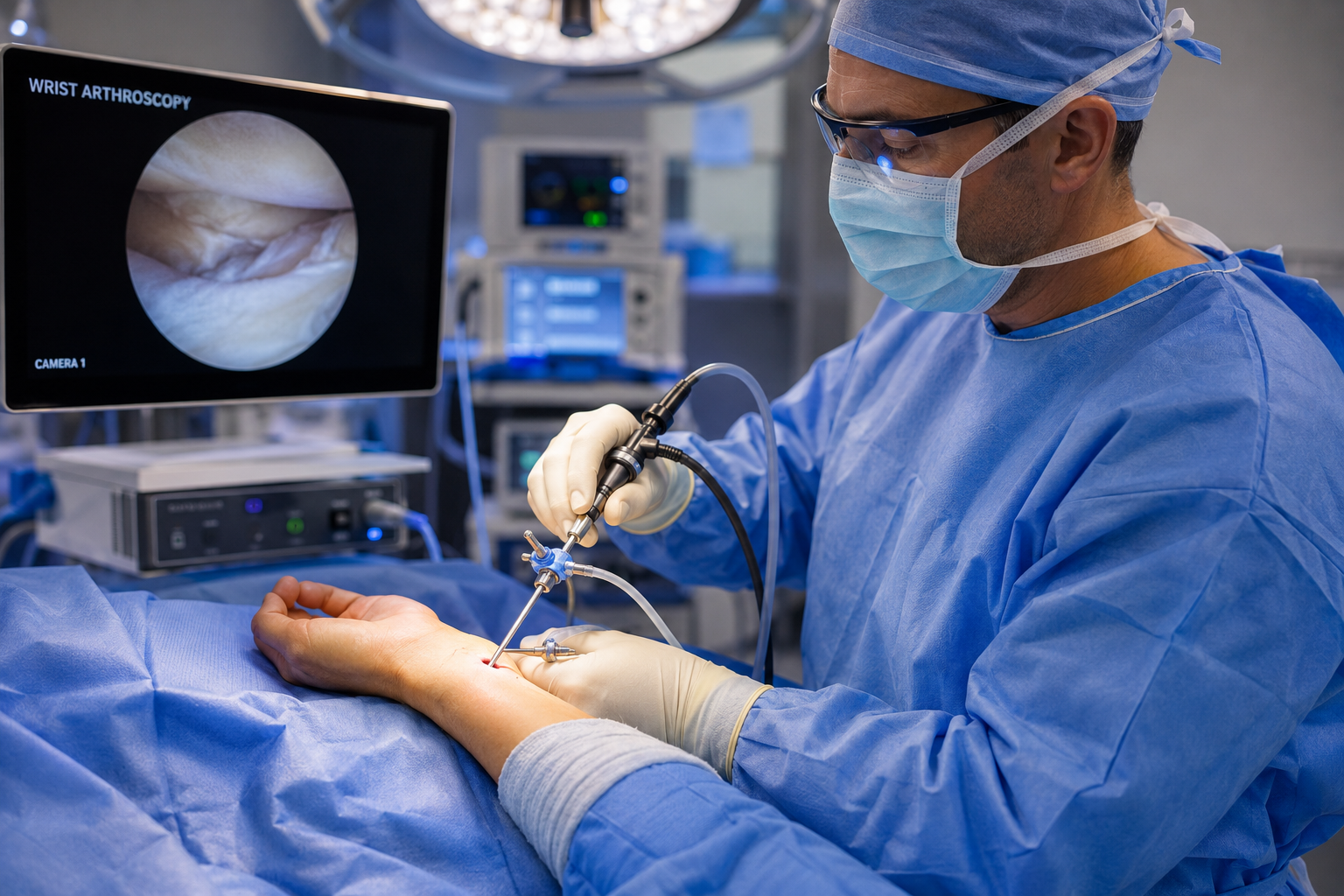
Wrist Arthroscopy — Minimally invasive surgery using a pencil-sized arthroscope inserted through tiny incisions to diagnose and treat chronic wrist pain, ligament tears, TFCC tears, ganglion cysts, and certain wrist fractures.
Distal Radius Fracture Surgery (ORIF) — Open reduction and internal fixation for unstable or displaced wrist fractures, typically using a volar plate and screws.
Scaphoid Fracture Surgery — Percutaneous or open fixation of scaphoid fractures using a single compression screw. Often used for displaced fractures or for high-demand patients to allow faster return to activity.
Trigger Finger Release — Minor outpatient procedure to release the tight A1 pulley over the flexor tendon, eliminating the catching and locking.
De Quervain's Release — Outpatient procedure to release the first dorsal compartment tendons in persistent De Quervain's tenosynovitis that has not responded to splinting and injection.
Ganglion Cyst Excision — Surgical removal of symptomatic or recurrent ganglion cysts.

When to See a Wrist Specialist
Mild wrist pain — particularly after unusually heavy use — often resolves with a few days of rest, ice, and over-the-counter anti-inflammatory medication. You should see a wrist specialist if you experience any of the following:
Wrist pain lasting more than one to two weeks despite rest and OTC medication
Wrist pain following a fall, especially a fall on an outstretched hand
Nighttime numbness or tingling in the thumb, index, or middle fingers — the classic sign of carpal tunnel syndrome
Numbness or tingling in the pinky and ring finger — suggesting cubital tunnel syndrome
Wrist swelling that does not resolve
Weakness in grip or dropping objects
An obvious wrist deformity
Difficulty rotating the forearm or bending the wrist
A lump or mass on the wrist or hand
Locking, catching, or popping in a finger or thumb (trigger finger)
Pain at the base of the thumb with pinching motions (possible thumb arthritis or De Quervain's)
Any wrist injury sustained at work — especially if symptoms are bilateral or developed gradually with repetitive use
Seek immediate evaluation for:
Obvious wrist or hand deformity
Severe pain with numbness or pale color in the fingers
An open wound with bone or tendon visible
Inability to feel or move the fingers
Aptiva's Approach to Wrist Care
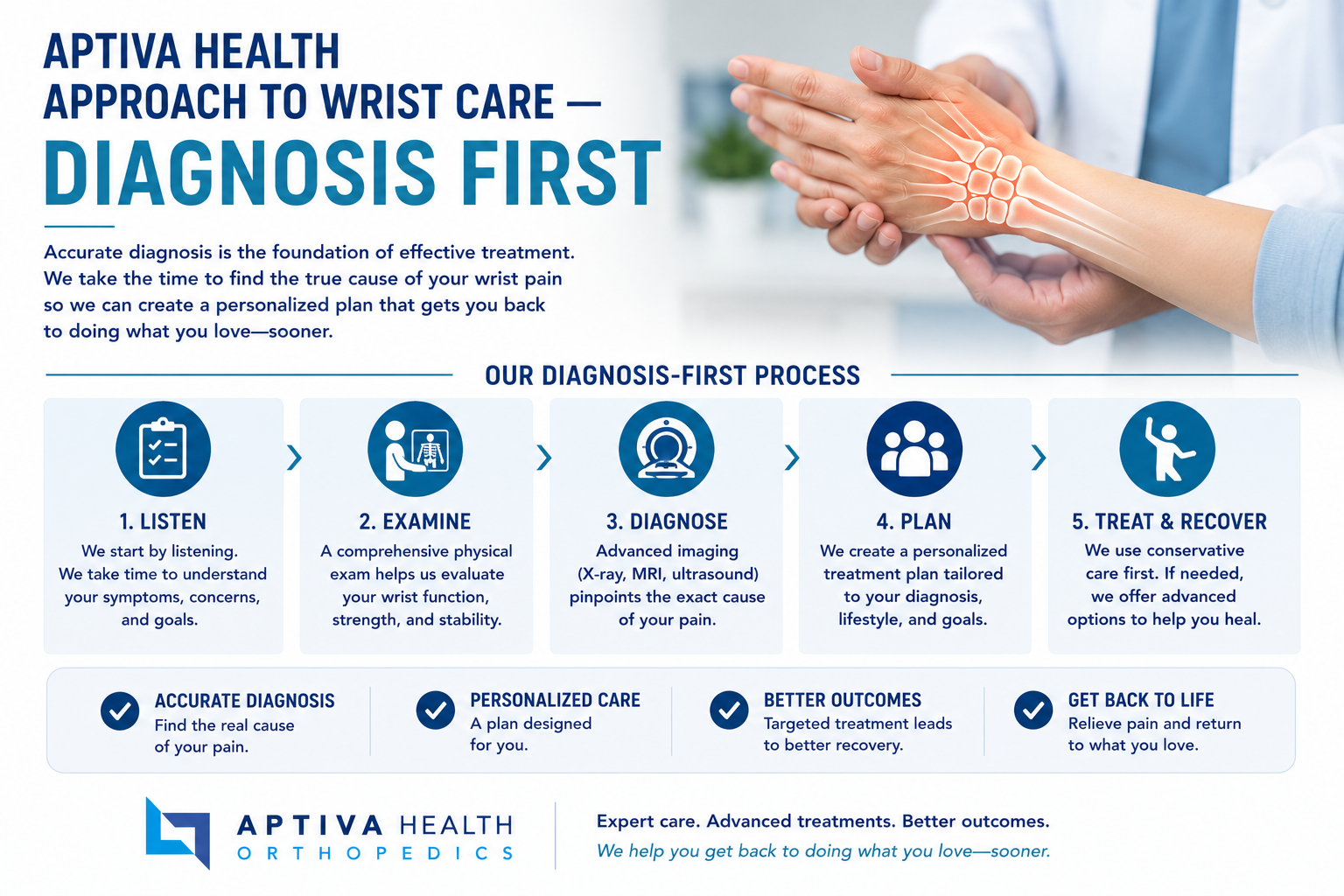
Diagnosis first — because wrist pain has dozens of causes. A focused history (especially how the injury occurred, the pattern of numbness or weakness, and what makes symptoms worse) plus a thorough physical exam (range of motion, provocative tests, grip strength, nerve testing) identifies most wrist conditions accurately. On-site X-ray is available at every Aptiva location for acute injuries, and MRI, CT, and nerve conduction studies are available when needed.
Conservative care first. Most wrist conditions respond to a structured course of non-surgical care. Our toolkit includes:
Splinting and bracing — custom and prefabricated wrist splints, including night splints for carpal tunnel
Anti-inflammatory medication
Activity modification and ergonomic guidance — particularly important for work-related wrist conditions
Physical and hand therapy — range of motion, strengthening, nerve gliding exercises, and ergonomic retraining
Corticosteroid injections for tendonitis, De Quervain's, trigger finger, ganglion cysts, and arthritis
Aspiration for symptomatic ganglion cysts
Surgery when it's the right answer. When conservative care has been exhausted, when the injury pattern requires surgical management, or when nerve compression has progressed to weakness or muscle wasting, we offer the full range of outpatient wrist procedures using modern minimally invasive techniques.
Second opinions welcome. We routinely see patients who have been told they need carpal tunnel surgery or other wrist surgery elsewhere and want an independent evaluation before proceeding. Our team will review your imaging and nerve studies, conduct an independent assessment, and discuss whether the recommended procedure is the best option — or whether an alternative might be appropriate.
Your Aptiva Health Wrist Care Team
At Aptiva Health, your wrist and hand care is delivered by a multidisciplinary team of board-certified orthopedic surgeons, sports medicine specialists, advanced practice providers, and physical therapists.

Dr. D. Philip Stickney — Board-certified orthopedic surgeon since 2002 with 25+ years of experience. Treats the full range of hand and wrist conditions including carpal tunnel syndrome, cubital tunnel syndrome, trigger finger, distal radius fractures, scaphoid fractures, ganglion cysts, and wrist tendonitis. Significant additional expertise in workers' compensation — served as Co-Medical Director of an Ohio workers' compensation organization managing complex work-related musculoskeletal injuries. Sees patients in Northern Kentucky (Hebron) and Indianapolis.

Dr. J. Steve Smith — Director of Orthopedic Surgery & Sports Medicine; Kerlan-Jobe sports medicine fellowship. Treats sports-related wrist injuries and acute trauma.

Dr. Timothy Wilson — Board-certified orthopedic surgeon with subspecialty certification in Sports Medicine from the American Board of Orthopaedic Surgery. Treats sports-related wrist conditions.

Dr. Shawn Price — Board-certified orthopedic surgeon; treats the full range of orthopedic conditions including wrist arthritis and trauma.
Advanced Practice Providers
Michael Gilbert, PA-C — Orthopedic physician assistant for 30 years. Provides same-week new-patient evaluations, conservative-care coordination, splinting and injections, and post-operative follow-up.
Bradley Stephenson, PA-C — Orthopedic physician assistant. Provides new-patient evaluations, conservative-care coordination, wrist injections, splint fittings, and post-operative follow-up for the Aptiva Health orthopedic team. (Verify Squarespace slug before adding hyperlink — bio page URL pending.)
Bryan Davidson, PA-C — Orthopedic physician assistant. Treats orthopedic patients across the Aptiva Health network. (Verify Squarespace slug before adding hyperlink — bio page URL pending.)
Becky Kostyo, APRN — Orthopedic nurse practitioner. Works directly with the Aptiva Health team to evaluate, diagnose, and manage wrist and hand conditions including conservative care, injections, and pre- and post-operative coordination.
Physical Therapy & Imaging
Aptiva's orthopedic physical therapy team includes hand and wrist therapists. On-site imaging including X-ray, MRI, and nerve conduction studies is integrated with the orthopedic team so your evaluation, imaging, and treatment all happen under one roof.

Where We Treat Wrist Injuries & Conditions
Aptiva Health treats wrist injuries and conditions across our network of locations in Kentucky and Indiana. One call connects you to any of our locations: 1-844-999-3627 (DOCS).
Louisville Metro
Aptiva Health — Louisville Central — 3615 Newburg Road, Louisville, KY 40218
Aptiva Health — Louisville East — 10100 Linn Station Road, Suite 1A, Louisville, KY 40223
Aptiva Health — Louisville Downtown — 300 South 13th Street, Louisville, KY 40203
Aptiva Health — Louisville Middletown — 401 N English Station Road, Suite 1A, Louisville, KY 40223
Aptiva Health Imaging (Louisville) — 3615 Newburg Road, Suite 106, Louisville, KY 40218
Concussion & Sports Medicine Institute — 3611 Newburg Road, Louisville, KY 40218
South of Louisville
Lexington / Central Kentucky
Aptiva Health — Lexington — 230 Fountain Court, Suite 180, Lexington, KY 40509
Aptiva Health Lexington MRI — 426 Codell Drive, Lexington, KY 40509
Aptiva Health Lexington Physical Therapy — 152 W Tiverton Way, Suite 180, Lexington, KY 40503
Northern Kentucky / Cincinnati Metro
Indianapolis
Main scheduling line for all locations: 1-844-999-3627 (DOCS)

Why Choose Aptiva Health for Your Wrist Care
Workers' compensation expertise. Dr. D. Philip Stickney served as Co-Medical Director of an Ohio workers' compensation organization, managing complex work-related musculoskeletal injuries from initial evaluation through return-to-work clearance. Wrist conditions — particularly carpal tunnel syndrome and other repetitive strain injuries — are among the most common workers' comp claims, and Aptiva is structured to handle them efficiently.
Diagnosis in a single visit. Most patients can complete a focused history, physical exam, X-ray, and have a treatment plan in a single appointment. On-site X-ray, MRI, and nerve conduction studies are available across Aptiva locations.
Conservative care first. Most wrist conditions — including carpal tunnel syndrome — can be managed without surgery. We don't push surgery. We recommend the least invasive option that will work, and we reserve surgery for the situations where it's truly indicated.
Same-day and walk-in appointments. Most patients see a wrist specialist within days — and walk-in immediate injury care is available across our locations. For acute wrist injuries from falls, sports, work, or auto accidents, prompt evaluation with on-site X-ray ensures fractures are not missed.
A complete continuum under one roof. From on-site X-ray and MRI to nerve conduction studies, physical and hand therapy, splinting, injections, and surgery — we offer the complete wrist care continuum so you're not bounced between unrelated providers and facilities.
Multiple convenient locations. Care is available across Louisville, Elizabethtown, Mount Washington, Lexington, Northern Kentucky, and Indianapolis.
Direct access — no referral needed. Schedule directly without a physician referral. We welcome second-opinion patients, including those who have been told elsewhere they need carpal tunnel or other wrist surgery.
Transparent insurance and cash-pay pricing. We accept most major insurance, Medicare, Medicaid Managed Care, workers' compensation, and auto insurance (PIP and Medpay). For self-pay patients, transparent bundled pricing and affordable cash-pay imaging are available.
Documentation that supports your case. For wrist injuries from work or auto accidents, our team works directly with employers, adjusters, attorneys, MCOs, and third-party administrators on documentation, return-to-work planning, FCEs, and AMA impairment ratings.
Schedule your appointment today!
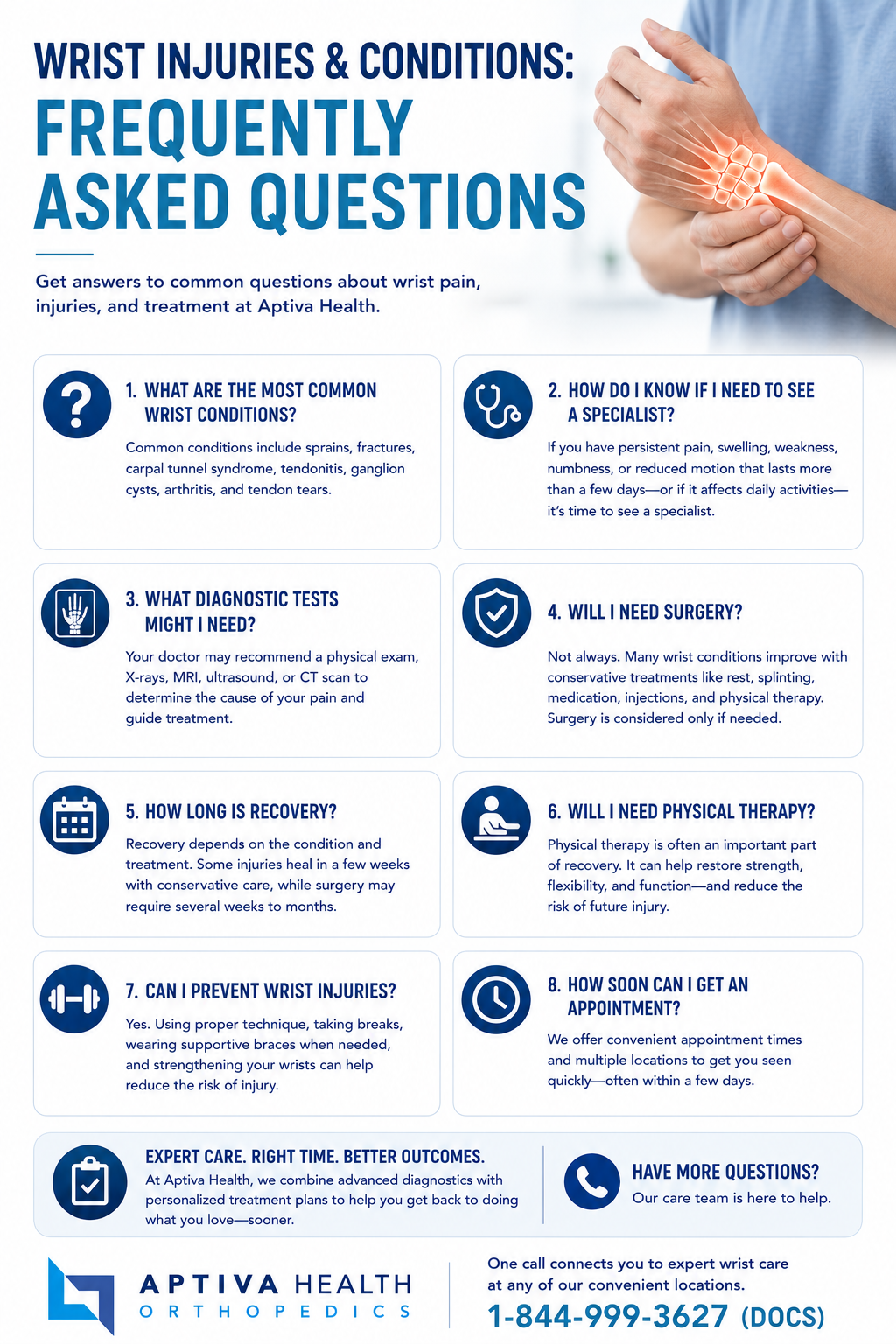
Wrist Injuries & Conditions: Frequently Asked Questions
What are the most common wrist injuries and conditions?
The most common wrist conditions fall into five categories. Nerve compression disorders include carpal tunnel syndrome (the most common wrist condition overall) and cubital tunnel syndrome. Tendon conditions include De Quervain's tenosynovitis, wrist tendonitis, and trigger finger. Acute injuries include distal radius fractures (the most common fracture in adults), scaphoid fractures, wrist sprains, and TFCC tears. Joint conditions include wrist osteoarthritis, rheumatoid arthritis, and gout. Soft tissue masses include ganglion cysts. Carpal tunnel syndrome is by far the most commonly treated wrist condition and is a leading cause of work-related disability.
When should I see a doctor for wrist pain?
You should see a doctor for wrist pain that persists more than one to two weeks despite rest and over-the-counter pain medication, wrist pain following a fall or other injury (especially if you fell on an outstretched hand), nighttime numbness or tingling in the thumb, index, or middle fingers (a classic sign of carpal tunnel syndrome), wrist swelling that does not resolve, weakness or difficulty gripping objects, dropping things, an obvious deformity, or any wrist injury sustained at work. At Aptiva Health, same-day and walk-in wrist evaluations are available across all locations.
What does carpal tunnel feel like?
Carpal tunnel syndrome typically begins with numbness, tingling, or pins-and-needles sensations in the thumb, index finger, middle finger, and the inner half of the ring finger — the pinky is almost never involved. Symptoms are usually worst at night and often wake patients up. Many people describe shaking the hand to relieve the numbness. As the condition progresses, symptoms persist during the day, especially with activities like gripping a steering wheel or holding a phone. Advanced carpal tunnel can cause hand weakness, dropping objects, and visible wasting of the muscle at the base of the thumb.
What is the difference between carpal tunnel syndrome and cubital tunnel syndrome?
Both are nerve compression syndromes affecting the upper extremity, but they involve different nerves and affect different fingers. Carpal tunnel syndrome is compression of the median nerve at the wrist and causes numbness or tingling in the thumb, index, middle, and inner half of the ring finger. Cubital tunnel syndrome is compression of the ulnar nerve at the elbow and causes numbness or tingling in the pinky and the outer half of the ring finger, often with elbow pain. Distinguishing them is straightforward with a focused history and physical exam, and both are commonly treated at Aptiva Health.
Is my wrist broken or sprained?
It is often impossible to tell the difference between a broken wrist and a sprained wrist by symptoms alone — both can cause significant pain, swelling, and difficulty moving the wrist. A wrist X-ray is the only reliable way to differentiate, and even then, certain fractures (particularly scaphoid fractures) can be missed on initial X-rays and only become apparent days later or on MRI. Any wrist injury severe enough to cause persistent pain, significant swelling, deformity, or inability to use the wrist should be evaluated by an orthopedic provider with X-ray available. Aptiva Health offers same-day evaluation with on-site X-ray across all locations.
Do I need surgery for carpal tunnel syndrome?
Not always. Most patients with mild to moderate carpal tunnel syndrome respond to conservative treatment including nighttime wrist splinting, anti-inflammatory medication, activity modification, and corticosteroid injections. Surgery — carpal tunnel release — is typically considered when conservative treatment has failed, when symptoms have persisted for six months or longer, when nerve conduction studies show significant median nerve dysfunction, or when there is hand weakness or muscle wasting at the base of the thumb. Carpal tunnel release is an outpatient procedure with most patients returning to desk work within one to two weeks.
Are ganglion cysts dangerous?
No. Ganglion cysts are noncancerous, fluid-filled lumps that most commonly develop along the tendons or joints of the wrist or hand. They are not dangerous and do not turn into cancer. Many ganglion cysts cause no symptoms and resolve on their own without treatment. Ganglion cysts that cause pain, interfere with hand function, or are cosmetically bothersome can be treated with aspiration (drainage with a needle) or surgical excision.
How is a wrist injury diagnosed?
Wrist evaluation at Aptiva Health begins with a focused history of how the injury occurred or how the symptoms began. A thorough physical exam evaluates range of motion, tenderness over specific anatomic landmarks, provocative tests for nerve compression (Tinel's sign and Phalen's test for carpal tunnel), grip and pinch strength, and stability. X-rays are obtained when needed to evaluate for fracture or arthritis. MRI or CT may be added for soft tissue evaluation, suspected scaphoid fracture, or TFCC injury. Nerve conduction studies and electromyography (EMG) may be ordered for suspected nerve compression to confirm diagnosis and assess severity.
Does Aptiva Health treat work-related wrist injuries?
Yes. Wrist conditions — especially carpal tunnel syndrome and other repetitive strain injuries — are among the most common workers' compensation claims in the United States. Aptiva Health is experienced in treating work-related wrist injuries, accepts workers' compensation through most major carriers in Kentucky and Indiana, and handles documentation, return-to-work planning, functional capacity evaluations, AMA impairment ratings, and IMEs. Our team works directly with employers, adjusters, MCOs, and third-party administrators to coordinate care from initial evaluation through return-to-work clearance.
Do I need a referral to see a wrist specialist at Aptiva Health?
No. You can schedule directly with Aptiva Health without a physician referral. We also welcome patients seeking a second opinion, including those who have been told they need wrist or carpal tunnel surgery elsewhere and want an independent evaluation before proceeding.
Does Aptiva Health offer same-day wrist appointments?
Yes. Aptiva Health offers same-day and walk-in appointments for wrist injuries and conditions across all of our locations in Louisville, Elizabethtown, Mount Washington, Lexington, Northern Kentucky (Hebron), and Indianapolis. Same-day appointments are particularly important for acute wrist injuries from falls, sports, work, or auto accidents, where prompt evaluation with on-site X-ray ensures fractures are not missed. Call 1-844-999-3627 (DOCS) to schedule.
What insurance does Aptiva Health accept for wrist care?
Aptiva Health accepts most major insurance plans, Medicare, Medicaid Managed Care, workers' compensation, and auto insurance (PIP and Medpay). Coverage typically includes office visits, X-ray, MRI, nerve conduction studies, physical therapy, wrist injections, splinting and bracing, and wrist surgery when needed. Our team verifies benefits before any visit or procedure and can also provide cash-pay pricing for patients without insurance or with high-deductible plans.
Sources: Mayo Clinic and AAOS OrthoInfo.