


MILD Procedure
MILD (minimally invasive lumbar decompression) is an outpatient procedure that lasts less than one hour and requires no general anesthesia, implants or stitches. The process is performed through a tiny incision in the lower back and involves removing small fragments of bone and excess ligament tissue to restore space in the spinal canal and decrease the compression of nerves. Clinical studies show that 79 percent of patients who underwent the MILD procedure experienced a 53 percent reduction in pain and a 34 percent increase in mobility within a year.
With this procedure, needle-like instruments are used to remove a portion of a thickened ligament in the back of the spinal column to increase spinal canal space and remove nerve root impingement. Only patients with lumbar spinal stenosis and a thickened ligament are eligible for this type of decompression.
The procedure is called percutaneous image-guided lumbar decompression (PILD) or is more commonly known as the minimally invasive lumbar decompression (MILD). Because MILD is performed without general anesthesia, it may be an option for some people with high surgical risks from other medical problems and is considered a safer alternative for some patients.
If leg pain, heaviness, or cramping forces you to stop and rest when you walk or stand, and injections and therapy have stopped giving lasting relief, the MILD procedure may be an option before you consider spine surgery. MILD - minimally invasive lumbar decompression - is a same-day, image-guided procedure that relieves the nerve compression behind lumbar spinal stenosis without general anesthesia, implants, stitches, or fusion. At Aptiva Health, MILD is performed by double board-certified interventional pain physician Dr. Steven Ganzel, DO, as one step in a complete spine program where evaluation, MRI, the procedure, and rehabilitation all happen under one roof.
Schedule your appointment today!

What the MILD procedure treats
MILD is designed for one specific cause of lumbar spinal stenosis: a thickened ligamentum flavum crowding the spinal canal. As this ligament enlarges with age, it narrows the space around the nerves, producing the classic pattern of leg pain and heaviness that worsens with standing or walking and eases when you sit or lean forward - known as neurogenic claudication.
MILD does not treat every kind of stenosis. If your narrowing is driven mainly by bone, disc, or instability, a different treatment is the better fit, and your physician will tell you so after reviewing your MRI.
How the MILD procedure works
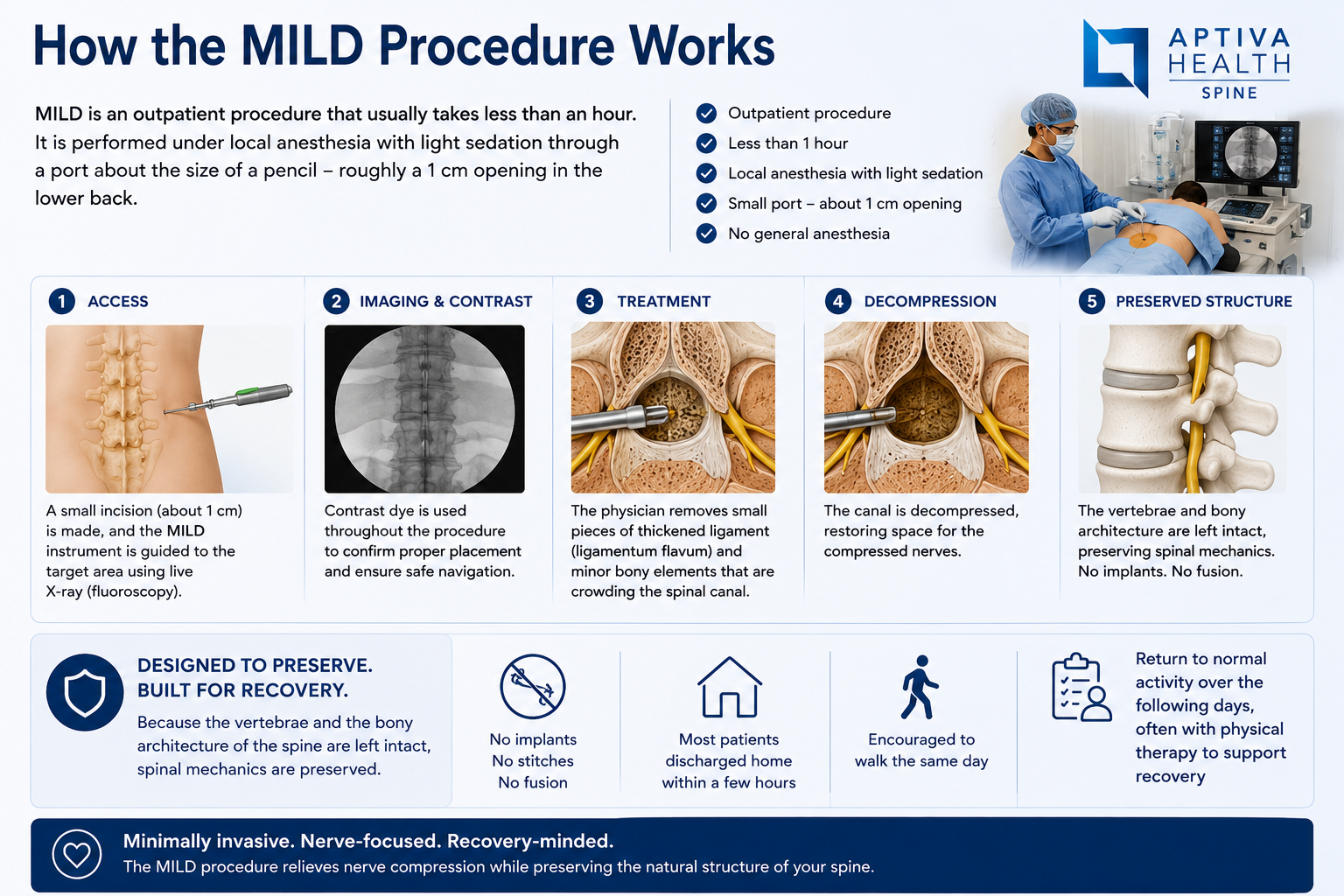
MILD is an outpatient procedure that usually takes less than an hour. It is performed under local anesthesia with light sedation through a port about the size of a pencil - roughly a 1 cm opening in the lower back. Using image guidance, the physician removes small pieces of the thickened ligament and minor bony elements crowding the canal, restoring space for the compressed nerves. Contrast is used throughout to confirm positioning.
Because the vertebrae and the bony architecture of the spine are left intact, spinal mechanics are preserved. There are no implants, no stitches, and no fusion. Most patients are discharged home within a few hours and are encouraged to walk the same day, then return to normal activity over the following days, often with physical therapy to support recovery.
Why patients choose MILD at Aptiva Health
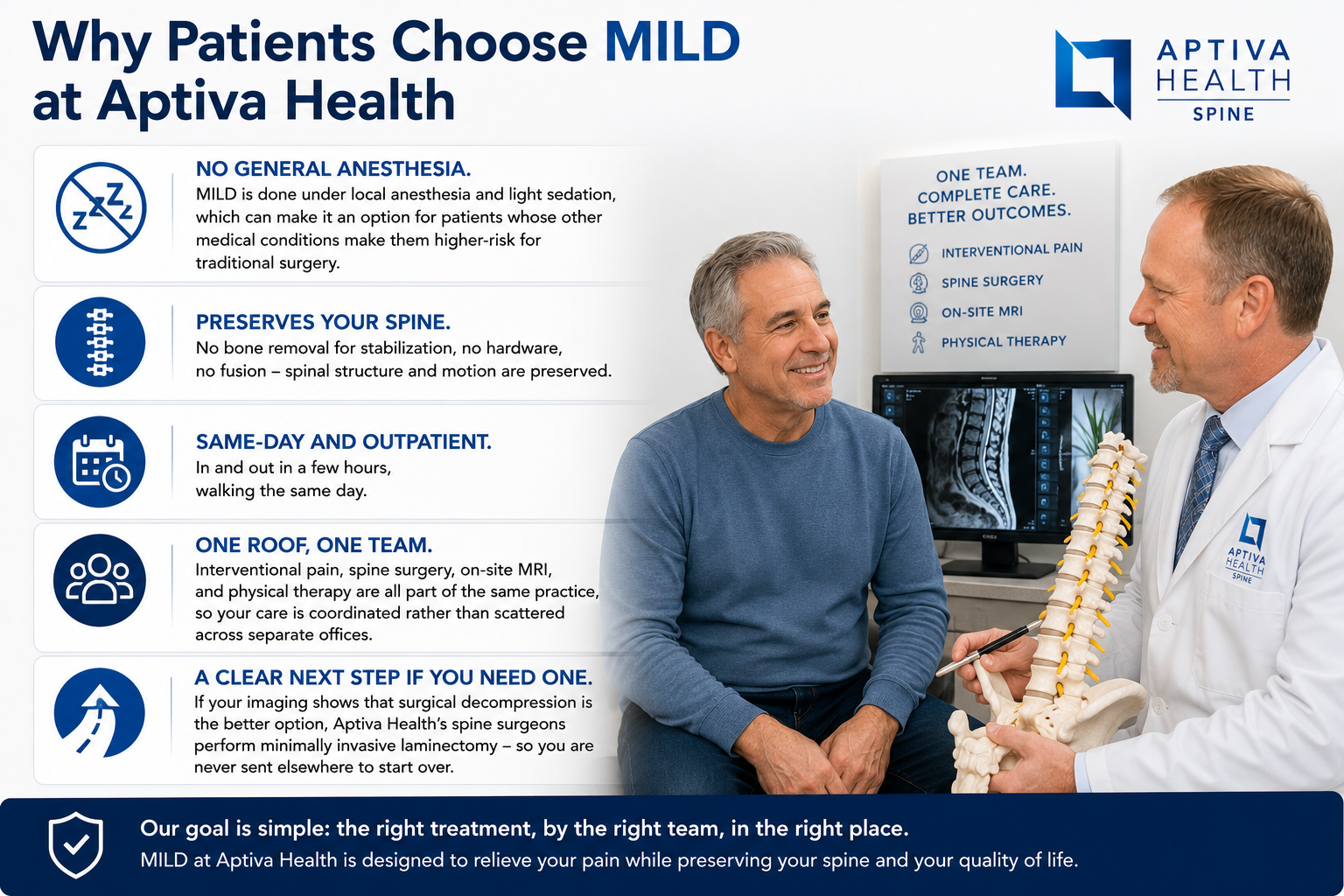
No general anesthesia. MILD is done under local anesthesia and light sedation, which can make it an option for patients whose other medical conditions make them higher-risk for traditional surgery.
Preserves your spine. No bone removal for stabilization, no hardware, no fusion - spinal structure and motion are preserved.
Same-day and outpatient. In and out in a few hours, walking the same day.
One roof, one team. Interventional pain, spine surgery, on-site MRI, and physical therapy are all part of the same practice, so your care is coordinated rather than scattered across separate offices.
A clear next step if you need one. If your imaging shows that surgical decompression is the better option, Aptiva Health's spine surgeons perform minimally invasive laminectomy - so you are never sent elsewhere to start over.
MILD vs. Laminectomy: which decompression is right?
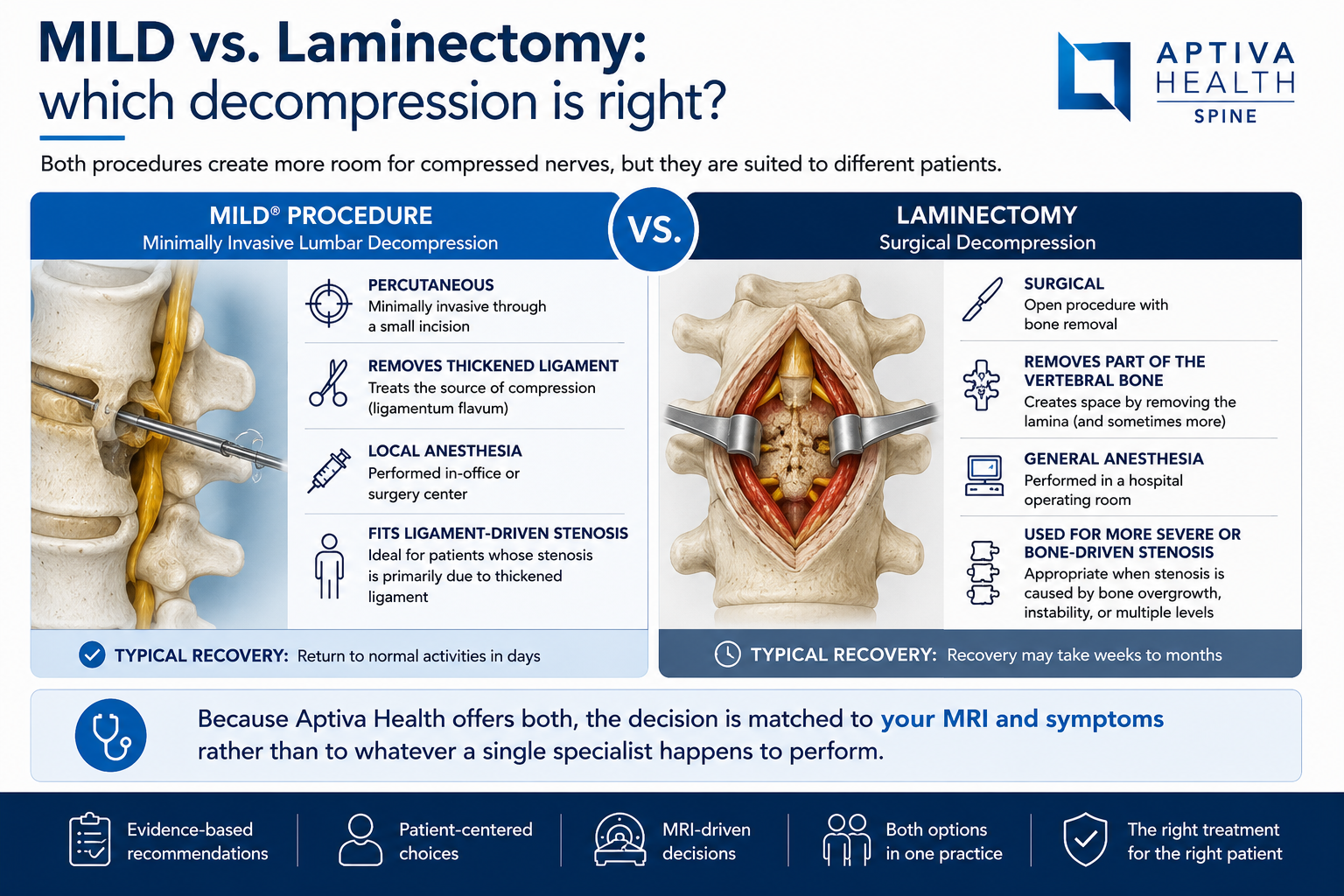
Both procedures create more room for compressed nerves, but they are suited to different patients. MILD is percutaneous and non-surgical, removes thickened ligament, uses local anesthesia, and fits ligament-driven stenosis. A laminectomy is a surgical decompression performed by a spine surgeon that removes part of the vertebral bone, and it is used for more severe or bone-driven stenosis. Because Aptiva Health offers both, the decision is matched to your MRI and symptoms rather than to whatever a single specialist happens to perform.
Your MILD Physician
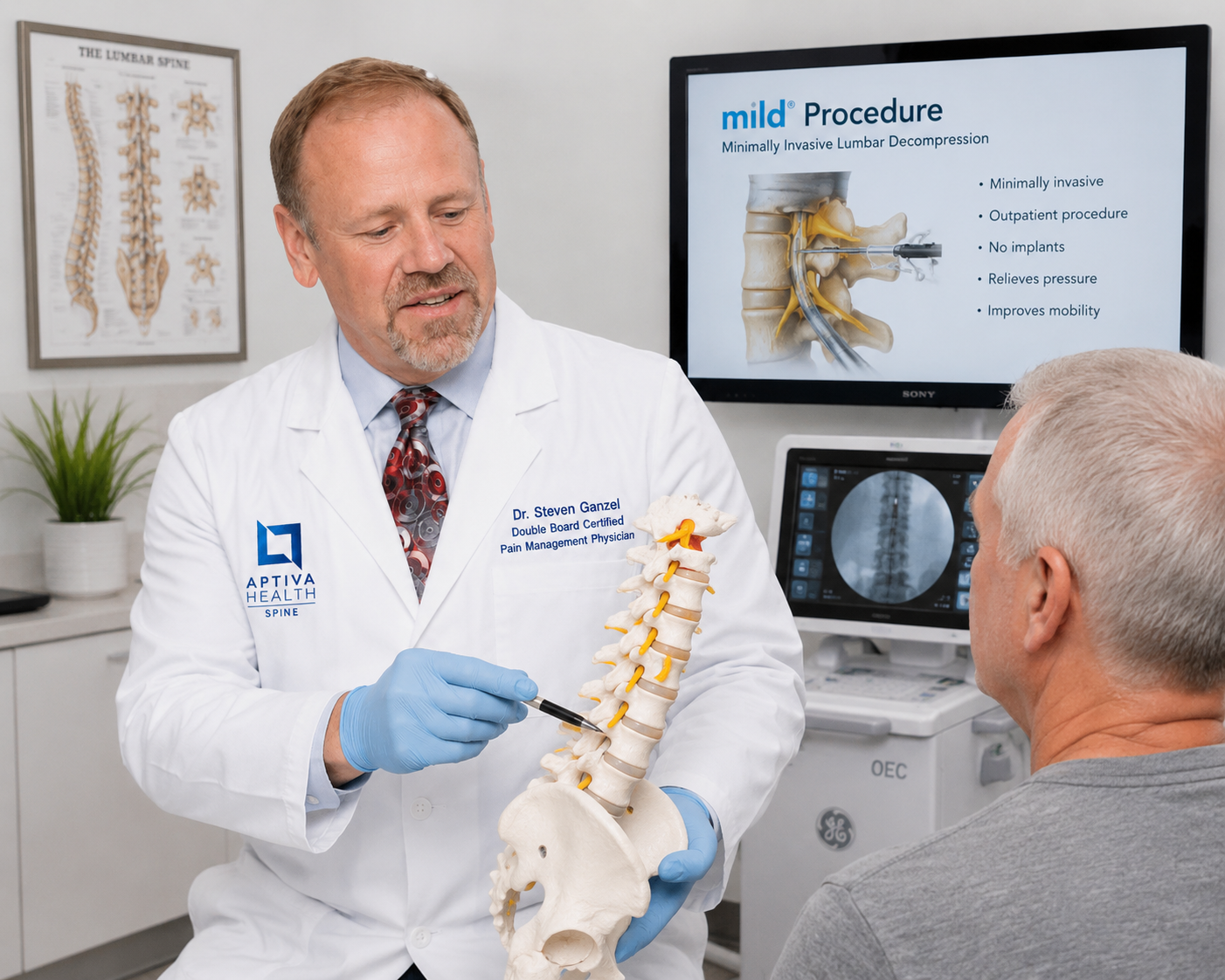
Dr. Steven Ganzel, DO is double board-certified in Physical Medicine & Rehabilitation and Interventional Pain Management and performs the full range of fluoroscopy-guided spine procedures at Aptiva Health, including MILD.
Supporting spine and pain care team: Kayla Troutman, PA-C, and David Koonce, DNP.
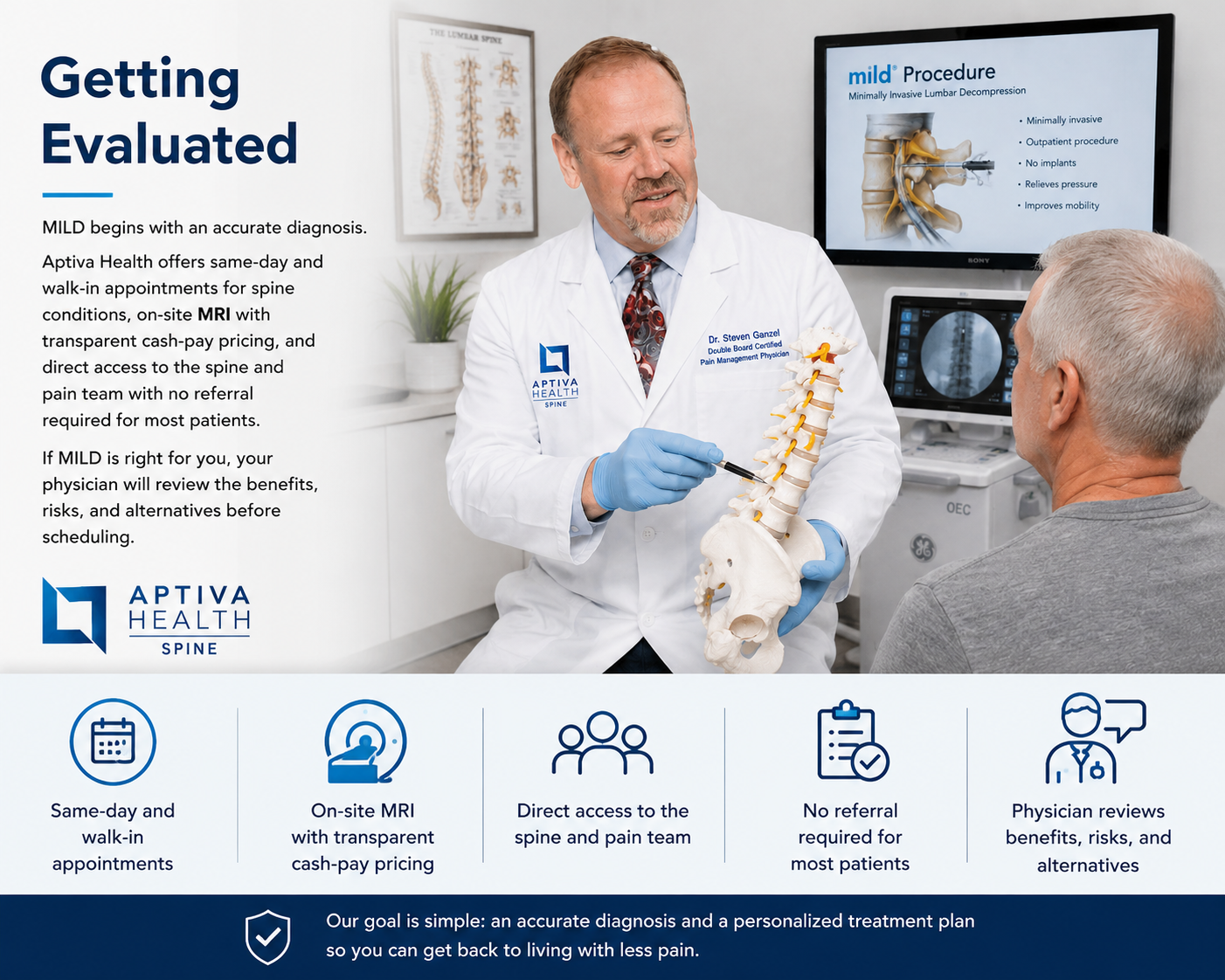
Getting Evaluated
MILD begins with an accurate diagnosis. Aptiva Health offers same-day and walk-in appointments for spine conditions, on-site MRI with transparent cash-pay pricing, and direct access to the spine and pain team with no referral required for most patients. If MILD is right for you, your physician will review the benefits, risks, and alternatives before scheduling.
Questions? Call 1-844-999-3627 or schedule an appointment.