


Medial Branch Block: Pinpointing the Source of Facet Joint Pain
If you have back or neck pain that sits close to the spine, worsens when you lean back or twist, and does not shoot down your leg, the cause may be your facet joints - the small paired joints that link the vertebrae. A medial branch block is a short, image-guided diagnostic injection that tells your physician, clearly and reliably, whether those joints are the source of your pain. At Aptiva Health, it is performed by double board-certified interventional pain physician Dr. Steven Ganzel, DO, as one step in a complete facet-pain program - available across Kentucky and Indiana - where the diagnosis and the treatment happen under the same roof.
Schedule your appointment today!
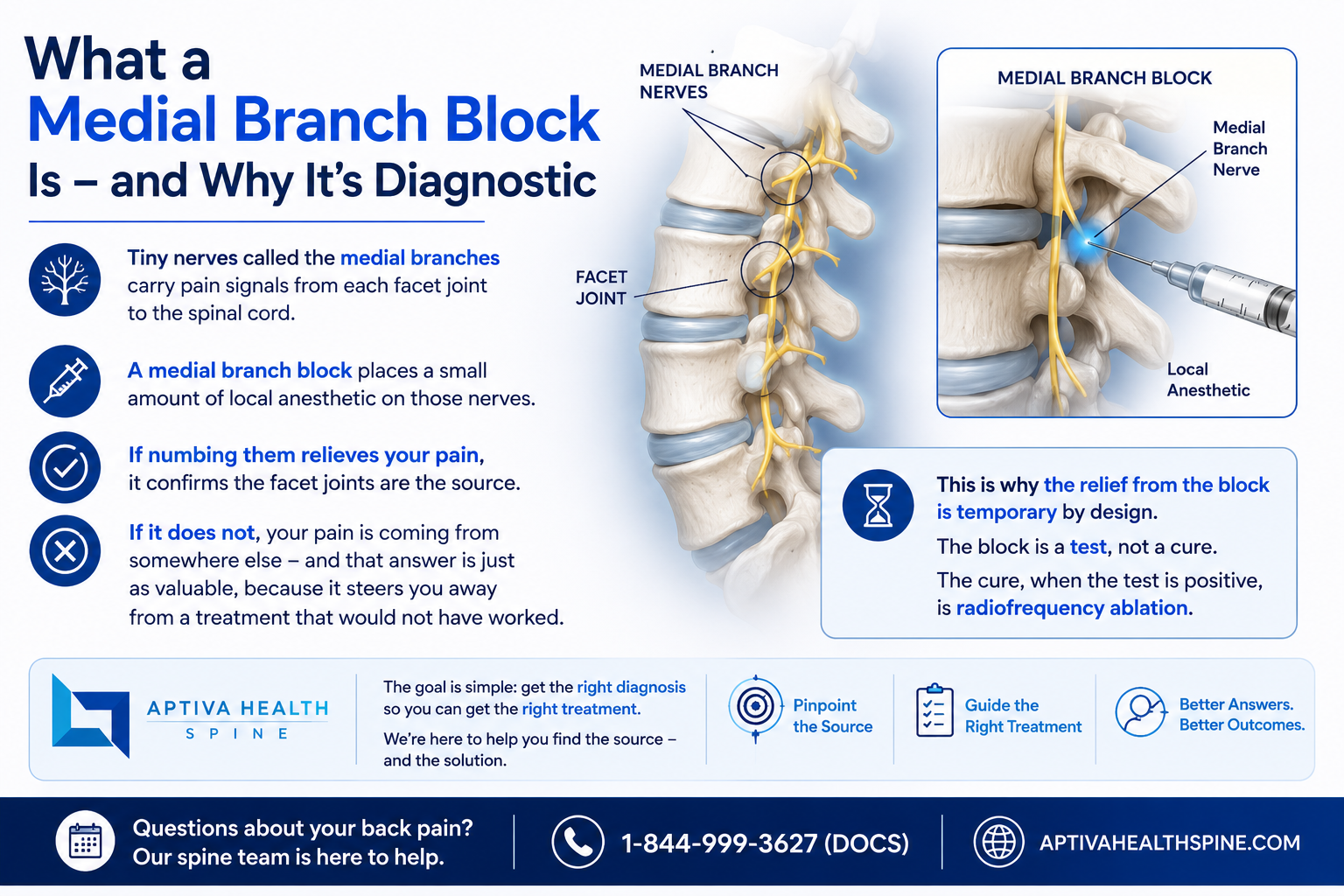
What a medial branch block is - and why it's diagnostic
Tiny nerves called the medial branches carry pain signals from each facet joint to the spinal cord. A medial branch block places a small amount of local anesthetic on those nerves. If numbing them relieves your pain, it confirms the facet joints are the source. If it does not, your pain is coming from somewhere else - and that answer is just as valuable, because it steers you away from a treatment that would not have worked.
This is why the relief from the block is temporary by design. The block is a test, not a cure. The cure, when the test is positive, is radiofrequency ablation.

Is Facet Joint Pain what you have?
Facet joint pain is typically felt close to the midline of the lower back or neck, on one or both sides. It usually does not radiate below the knee and is rarely accompanied by numbness or tingling in the leg. It often worsens with standing, leaning backward, or twisting, and eases when you sit or bend forward. Because these patterns overlap with other spine conditions, an accurate diagnosis - which is exactly what a medial branch block provides - is the most reliable way to be sure.
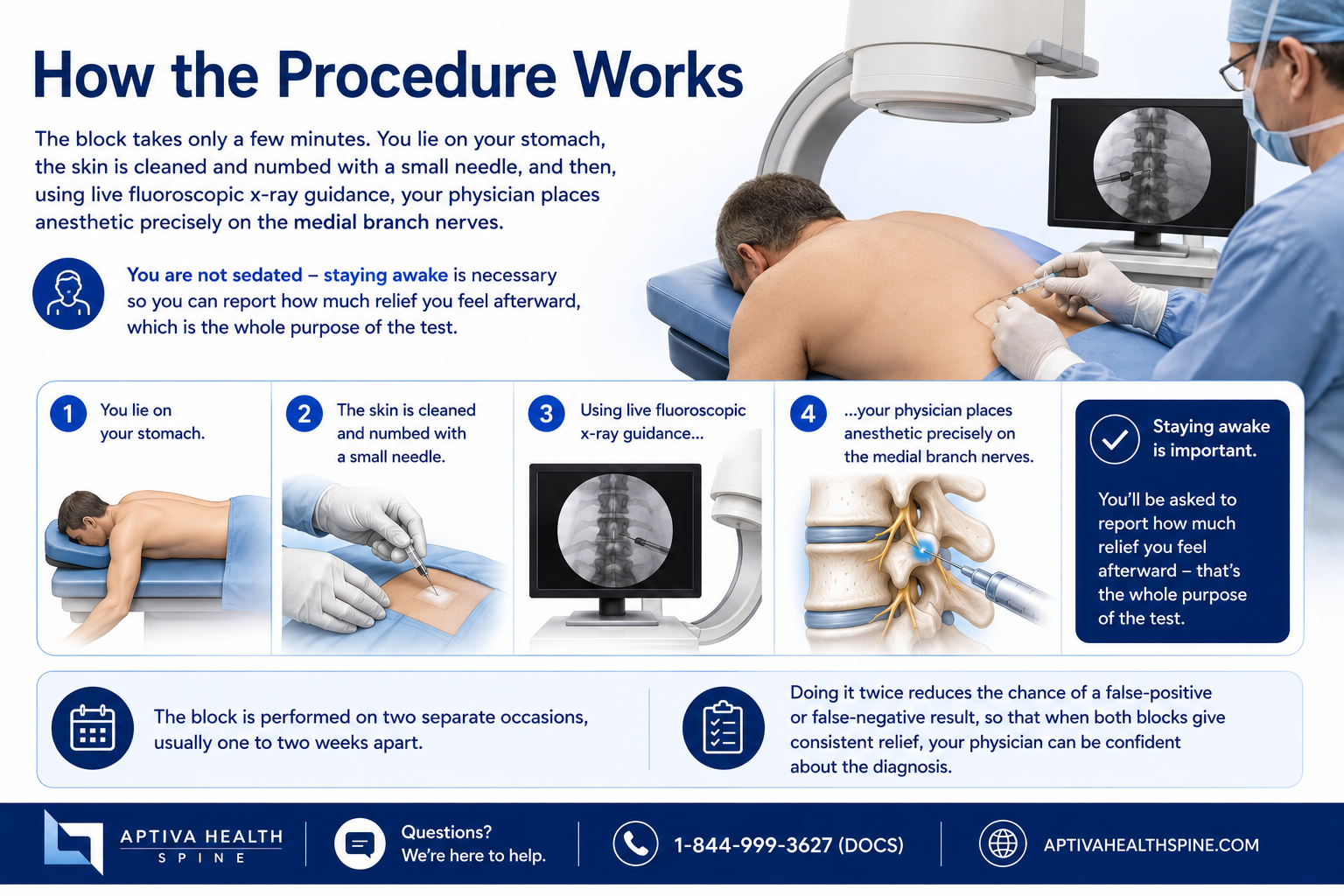
How the Procedure Works
The block takes only a few minutes. You lie on your stomach, the skin is cleaned and numbed with a small needle, and then, using live fluoroscopic x-ray guidance, your physician places anesthetic precisely on the medial branch nerves. You are not sedated - staying awake is necessary so you can report how much relief you feel afterward, which is the whole purpose of the test.
The block is performed on two separate occasions, usually one to two weeks apart. Doing it twice reduces the chance of a false-positive or false-negative result, so that when both blocks give consistent relief, your physician can be confident about the diagnosis.
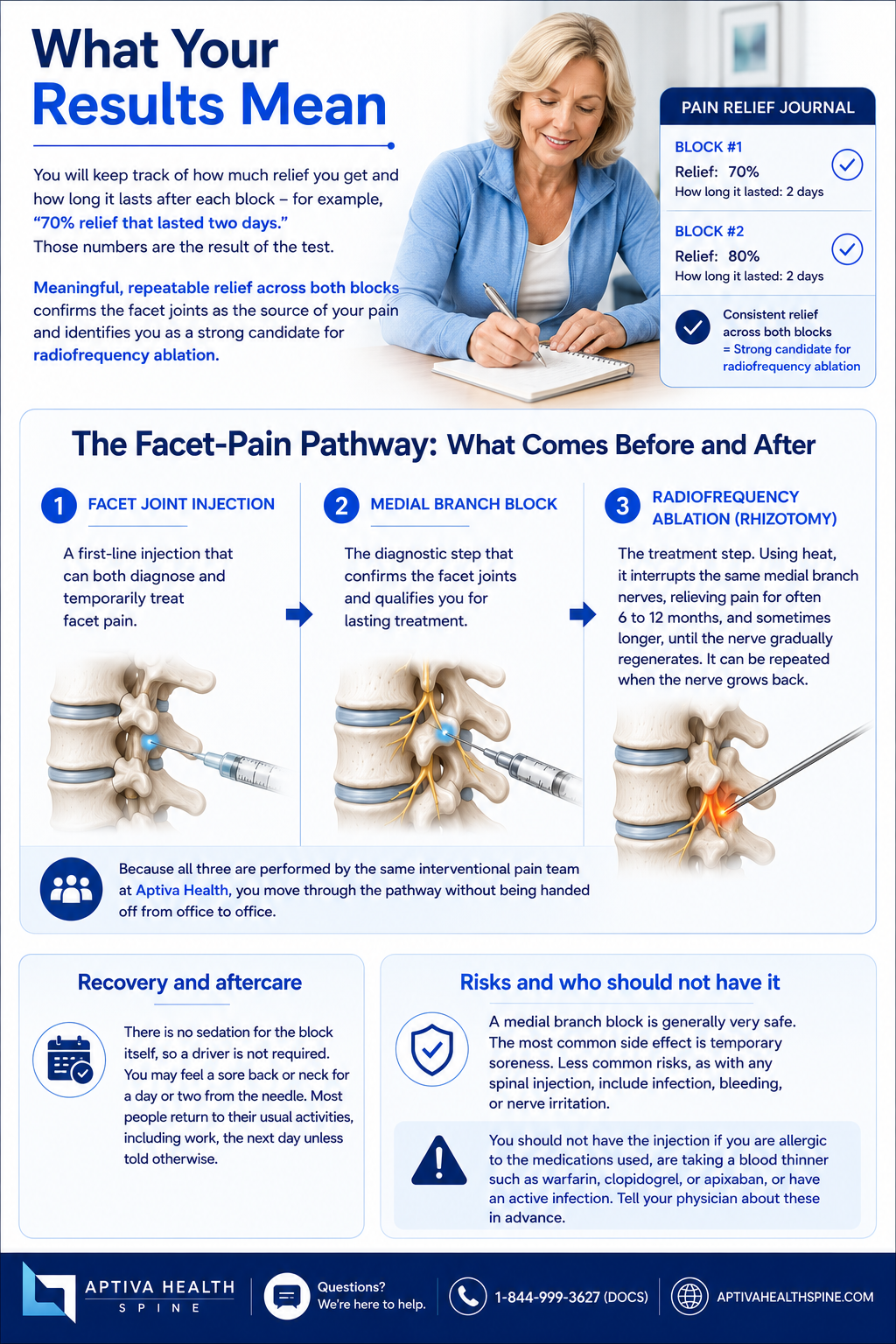
What your Results Mean
You will keep track of how much relief you get and how long it lasts after each block - for example, "70% relief that lasted two days." Those numbers are the result of the test. Meaningful, repeatable relief across both blocks confirms the facet joints as the source of your pain and identifies you as a strong candidate for radiofrequency ablation.
The facet-pain pathway: what comes before and after
Facet joint injection - a first-line injection that can both diagnose and temporarily treat facet pain.
Medial branch block - the diagnostic step that confirms the facet joints and qualifies you for lasting treatment.
Radiofrequency ablation (rhizotomy) - the treatment step. Using heat, it interrupts the same medial branch nerves, relieving pain for often 6 to 12 months, and sometimes longer, until the nerve gradually regenerates. It can be repeated when the nerve grows back.
Because all three are performed by the same interventional pain team at Aptiva Health, you move through the pathway without being handed off from office to office.
Recovery and aftercare
There is no sedation for the block itself, so a driver is not required. You may feel a sore back or neck for a day or two from the needle. Most people return to their usual activities, including work, the next day unless told otherwise.
Risks and who should not have it
A medial branch block is generally very safe. The most common side effect is temporary soreness. Less common risks, as with any spinal injection, include infection, bleeding, or nerve irritation. You should not have the injection if you are allergic to the medications used, are taking a blood thinner such as warfarin, clopidogrel, or apixaban, or have an active infection. Tell your physician about these in advance.
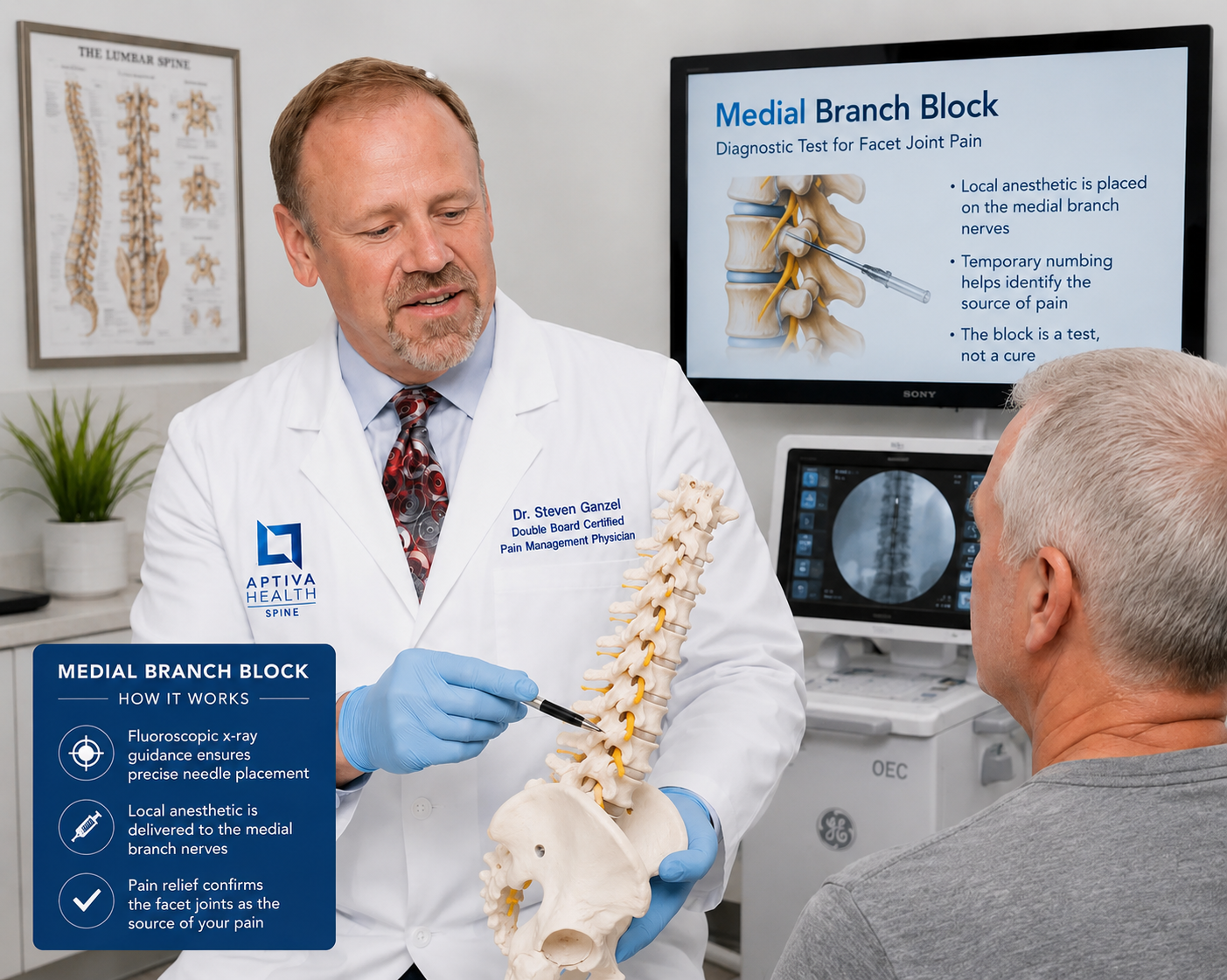
Why Patients Choose Aptiva Health for Facet-Pain Care
Diagnosis and treatment under one roof - the block, imaging, and RFA are all handled by the same team, so nothing gets lost in a referral.
A double board-certified specialist - Dr. Steven Ganzel, DO is board-certified in Physical Medicine & Rehabilitation and Interventional Pain and performs the full range of fluoroscopy-guided spine procedures.
Same-day and walk-in access and on-site imaging across Kentucky and Indiana, with no referral required for most patients.
Transparent cash-pay pricing for patients without insurance.
Medically reviewed by Steven Ganzel, DO on July 6, 2026.